

Cases, Buyer’s Guide
Arabic Numerals on a Tachometer | Custom Gauge Faces by GaugeFaces
Arabic numerals on a tachometer are one of the most distinctive and highly custom gauge face options we offer at GaugeFaces. To our knowledge, this is one of the rarest forms of gauge face customization available today, and it is something very few companies even attempt at a serious level. For our clients, it is not just about changing a font or a color. It is about creating an instrument cluster that feels personal, culturally relevant, visually striking, and completely different from anything found in a standard interior.
Over time, we have seen especially strong interest in Arabic-style tachometer layouts from clients in the UAE and Saudi Arabia. What began as a highly niche request quickly became one of the most memorable directions in our work. The reason is easy to understand. A tachometer sits at the center of the driving experience. When the numerals change, the entire cluster changes with them. The result feels more personal, more intentional, and in many cases far more special than a traditional layout.
At GaugeFaces, we have always believed that a gauge cluster should do more than display information. It should contribute to the identity of the car. It should feel like part of the build, part of the owner’s taste, and part of the story the interior tells. Arabic numerals on a tachometer are a perfect example of that philosophy in practice.
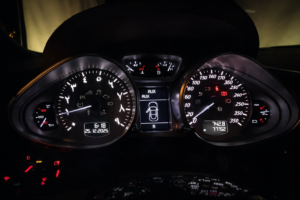
Night view of a custom cluster with Arabic numerals on the tachometer. One of the key goals in projects like this is not only design, but clean readability after dark.
Why Arabic Numerals on a Tachometer Feel So Special
Most custom gauge face projects stay within familiar boundaries. A different color. A different material. A cleaner font. A more aggressive scale. Arabic numerals on the tachometer go much further. They immediately change the visual language of the cluster.
That matters because the tachometer is often the emotional center of the dashboard. On many enthusiast cars, it is the first dial the driver notices and the one that carries the most personality. When Arabic numerals are introduced there, the result feels artistic without losing function. It becomes a custom detail that people remember instantly.
There is also an undeniable sense of rarity. Many automotive interiors are customized in similar ways, but very few are reimagined with this kind of regional and typographic identity. That is why these projects stand out so strongly. They feel bespoke in the truest sense of the word.
To Our Knowledge, We Are the Only Ones Doing This at This Level
GaugeFaces has built a reputation around highly unusual gauge face requests, but Arabic numeral tachometer projects occupy a category of their own. To our knowledge, we are the only company currently developing this kind of Arabic-style tachometer customization with this level of design intent, production flexibility, and attention to visual integration.
This is not a novelty sticker approach. It is not a temporary overlay concept. It is a fully considered gauge face project, designed to look like it belongs in the car and not like it was added as an afterthought. That difference is exactly why clients come to us for these ideas.
When people ask for something this specific, they are usually not looking for the cheapest or fastest route. They are looking for someone who understands how to turn an unusual idea into a dial that still feels resolved, elegant, and usable.
Why We Receive So Many Requests from the UAE and Saudi Arabia
Some custom requests are global. Others come with a very specific regional energy. Arabic numeral tachometer projects clearly belong to the second category. We have seen especially strong demand from clients in the UAE and Saudi Arabia, where the appetite for true personalization is high and where interior individuality matters just as much as exterior presence.
These clients are often not interested in generic customization. They want something that feels tailored, meaningful, and hard to replicate. Arabic numerals naturally create that effect. They give the cluster a recognizable regional identity while still preserving the performance-focused character of the car.
That combination is powerful. It is luxurious, but it is also personal. It is visually bold, but it still respects the dashboard architecture. This is one of the reasons we believe these projects resonate so strongly in those markets.
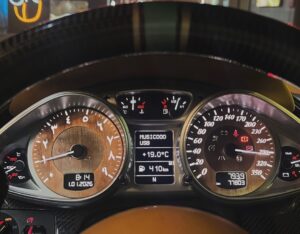
A closer look at one of our metallic Arabic-style tachometer projects. This kind of execution shows how the concept can become a true centerpiece of the interior.
Our Customization Range Goes Far Beyond One Style
One of the biggest advantages of working with GaugeFaces is that the concept does not stop at the numerals themselves. Arabic numerals on a tachometer can be interpreted in many different ways depending on the car, the mood of the project, and the owner’s vision.
Some clients want a clean monochrome dial with subtle Arabic figures and OEM-like restraint. Others want something far more expressive, with bold accent colors, unusual textures, and a dial that becomes a centerpiece in the cabin. Some prefer a modern execution. Others want a warmer, more heritage-inspired finish.
That is where our functionality matters. We can adapt layout, material direction, contrast, tone, and overall visual balance. We can build around a single tachometer or develop a broader gauge face concept around it. We can keep the rest of the cluster close to OEM, or push the project into much more custom territory.
In practical terms, that means we can create Arabic numeral tachometer designs in multiple directions: cleaner, sportier, more luxurious, more minimal, or more dramatic. The photos attached to this article reflect exactly that range. The same core idea can become night-focused and technical, warm and artisanal, or bold and graphic depending on the build.
Materials, Finish, and Night Readability Matter Just as Much as the Design
We do not see gauge face customization as a flat graphic exercise. A successful dial must work inside the real conditions of a real interior. Daytime readability matters. Night readability matters. Contrast matters. The way a material reflects ambient light matters. The way a dial feels against the rest of the cabin matters.
This is especially important with Arabic numeral tachometer designs, because the typography itself becomes a focal point. If the proportions are wrong, if the contrast is weak, or if the illumination is poorly handled, the concept loses its sophistication very quickly. Done correctly, however, the result can feel refined, rare, and deeply integrated into the car.
That is why these projects deserve more care than a standard cosmetic change. They are not just visual. They are experiential. The owner sees them every time the car starts, every time the lights come on, every time the cabin shifts from daytime to night.
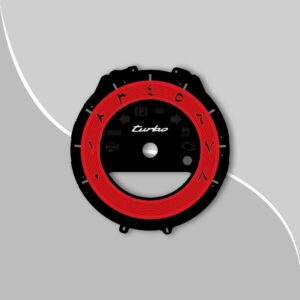
Arabic-style tachometer concept in red. This version shows how the same typographic idea can take on a more aggressive, performance-oriented character.
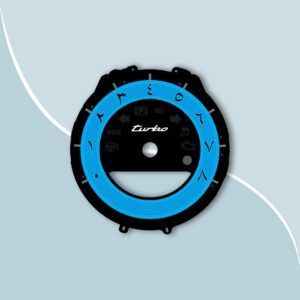
Arabic-style tachometer concept in blue. A cooler, cleaner interpretation of the same idea with a more modern visual tone.
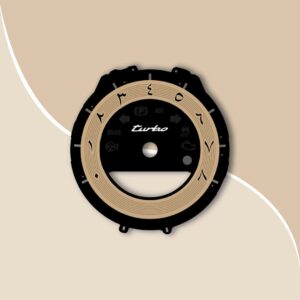
Arabic-style tachometer concept in sand beige. This palette feels warmer, more understated, and especially suited to refined interior builds.
The Audi R8 Project for a Client in Saudi Arabia
One of the most memorable examples of this direction was an extremely custom metallic gauge project we developed for an Audi R8 client in Saudi Arabia. This was not a standard print variation. It was a far more ambitious build, centered around a metal execution and a tachometer layout with Arabic numerals that gave the car a completely different character from factory.
Projects like that reflect what makes this category of work so exciting. They sit somewhere between industrial design, branding, personalization, and craftsmanship. The owner is not simply ordering another gauge face. He is commissioning a new interpretation of one of the most visible parts of the cockpit.
That is also why these projects tend to stay memorable long after they are finished. They are unusual, but not random. They are expressive, but not disconnected from the car. When the balance is right, they feel inevitable, as if the cluster was always meant to look that way.
Why This Kind of Custom Work Is Growing
We believe the demand for ultra-specific gauge face projects will continue to grow. Owners are becoming more selective. Many no longer want customization for the sake of customization. They want projects with meaning, coherence, and identity. Arabic numeral tachometers fit that direction perfectly.
They offer something rare in the automotive world: a form of personalization that is both immediate and subtle. Immediate because the cluster changes the feeling of the cockpit at once. Subtle because it still lives within the architecture of the car, instead of competing against it.
In other words, this is the kind of custom detail that can feel quietly luxurious or dramatically bespoke depending on how it is executed. That range is part of its appeal, and it is one of the reasons we enjoy working on these projects so much.
What Clients Can Customize with GaugeFaces
Arabic numerals on the tachometer are only the beginning. Depending on the project, clients can explore different colorways, finishes, materials, contrast levels, layout balance, and overall cluster direction. Some prefer a single standout dial. Others want the whole instrument set developed around one idea.
We can create a result that stays close to the original character of the car, or something far more individual. We can move toward a clean premium look, a motorsport-influenced look, a heritage-inspired tone, or a highly custom luxury execution. This flexibility is one of the reasons clients with unusual ideas continue to find us.
For owners in the Middle East especially, Arabic numeral tachometer designs have become one of the clearest examples of what bespoke gauge customization can look like when it is approached seriously.
Final Thoughts
Arabic numerals on a tachometer represent one of the most unique directions in custom gauge face design today. They combine cultural identity, visual rarity, and cockpit personalization in a way very few modifications can. To our knowledge, GaugeFaces is uniquely positioned in this space, and the growing number of requests we receive from the UAE and Saudi Arabia only confirms how strong the interest is.
From night-readable performance clusters to warmer artistic executions and even fully custom metal projects like the Audi R8 build for our client in Saudi Arabia, this category continues to evolve. And that is exactly what makes it so compelling.
If you want a tachometer that feels truly personal, Arabic numerals are not just a detail. They can become the signature element of the entire interior.
FAQ
Can GaugeFaces make a tachometer with Arabic numerals?
Yes. Arabic numeral tachometer projects are one of the most distinctive custom directions we offer, and they can be developed in multiple visual styles depending on the car and the client’s goal.
Do you only offer one Arabic-style design?
No. We can adapt the concept across different colors, finishes, materials, and overall cluster directions, from more OEM-like to fully bespoke.
Why are Arabic numeral tachometers popular with your clients in the UAE and Saudi Arabia?
Because they create a very personal and regionally meaningful interior detail while still feeling premium, rare, and integrated into the car.
Can Arabic numerals be combined with other custom materials?
Yes. Depending on the project, Arabic-style designs can be paired with a wide range of material and finish directions, including extremely custom concepts.
Did GaugeFaces make an Arabic numeral metal cluster for an Audi R8?
Yes. One of our standout projects was a highly custom metallic gauge concept with Arabic numerals on the tachometer for an Audi R8 client in Saudi Arabia.