

If a car was built for a market that uses miles per hour but is now driven in a country that uses kilometers per hour, converting the gauge cluster from mph to km/h is often the most natural solution. Owners usually make this change for three main reasons: easier daily driving, a cleaner and more factory-correct interior, and a better fit for a metric-market environment.
Converting a gauge cluster from miles to kilometers is one of the most common requests we receive from owners of imported cars. In many cases, the car itself is exactly right for the owner, but the cluster still reflects the market where it was originally sold. That creates a small but constant mismatch every time the driver looks down at the speedometer.
For some drivers, this is only a minor inconvenience. For others, it becomes one of the most noticeable details in the entire interior. When local road signs, speed limits, and daily driving habits are all based on km/h, reading speed in mph can feel unnatural every single day.
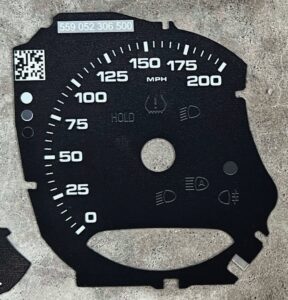
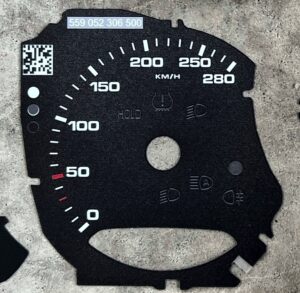
Example of a gauge cluster converted from miles to kilometers for cleaner metric-market readability.
Quick Answer
Drivers usually convert a gauge cluster from miles to kilometers because:
- the car was imported from an mph-market into a metric country
- local speed limits are shown in km/h
- daily driving feels more natural with direct km/h readability
- a proper conversion looks cleaner than temporary overlays or stickers
- the owner wants a more factory-correct interior for the local market
- the car is being restored, upgraded, or prepared for resale
Why Convert a Gauge Cluster from MPH to KM/H?
The most obvious reason is usability. If the roads around you are marked in kilometers per hour, a km/h speedometer is simply easier to read. There is no need for mental conversion, no guesswork at common speed limits, and no feeling that the cluster belongs to a different market.
Another reason is presentation. Temporary stickers, generic overlays, or improvised dual-scale solutions may technically solve the unit issue, but they rarely look right in a good interior. On enthusiast cars, premium cars, or restoration projects, a proper conversion usually looks much cleaner and more intentional.
There is also the resale and market-fit aspect. A car being driven, shown, or sold in a metric market often feels more complete when the cluster matches the local driving environment. Even when conversion is not strictly required, many owners still prefer the car to feel correct for the country where it lives.
Common Reasons Owners Request Miles to Kilometers Conversion
- The car was imported from the United States or another mph-market
- Local road signs and speed limits are shown in km/h
- The owner wants a more natural daily driving experience
- The interior should look cleaner and more OEM-like
- The car is being prepared for resale in a metric market
- The cluster is already being restored, repaired, or customized
- The owner wants to remove temporary stickers or secondary overlays
- The goal is a more factory-correct appearance for the current market
Why a Proper KM/H Conversion Looks Better Than a Temporary Fix
A good conversion is not just about replacing numbers. It is about making the cluster feel right.
When the typography, spacing, finish, and layout are handled properly, the result looks like it belongs in the car. That matters much more than many people expect. The gauge cluster sits directly in the driver’s line of sight. If it looks improvised, the whole dashboard can feel less refined.
That is why many owners prefer a proper custom gauge face instead of living with a workaround. A temporary fix may be acceptable for a short time, but it rarely feels like a final solution.
Imported Cars and Metric Markets
This issue is especially common with imported vehicles. A car may arrive from a market where mph is standard, but end up being used in a place where the driving culture, road signage, and customer expectations are based on km/h.
In that situation, the cluster becomes one of the last visual reminders that the car was built for somewhere else. For many owners, converting the dial is part of making the car feel fully adapted to its new home.
This is particularly relevant for drivers who use the car regularly rather than occasionally. The more often you drive, the more important fast and intuitive readability becomes.
Is MPH to KM/H Conversion Only About Appearance?
No. Appearance is only one part of it.
The practical side is just as important. A driver who reads speed directly in the same unit used on the road can react faster and drive more naturally. There is less friction in daily use, especially in city traffic, on highways, and in areas with frequent speed changes.
At the same time, appearance still matters because the cluster is one of the central visual elements of the interior. On many cars, a proper km/h conversion improves both function and overall cabin quality at the same time.
Do You Always Need to Convert the Entire Cluster?
Not always. It depends on the vehicle and on the owner’s goal.
In some projects, the main concern is only the speedometer scale. In others, the owner wants the cluster to match the target market more closely as a whole. Some people want a practical readability upgrade. Others want a full OEM-like result with no visible compromise.
The right approach depends on the model, the original cluster layout, and how complete the final conversion needs to feel.
Why This Upgrade Makes Sense During Restoration or Customization
Many owners choose miles to kilometers conversion at the same time as another cluster project.
If the cluster is already being refreshed, customized, repaired, or upgraded, it often makes sense to solve the unit issue at the same time. This creates a more coherent final result and avoids the feeling of doing the same area twice.
For restoration projects, it can also be a chance to make the cluster cleaner and more market-appropriate without sacrificing the spirit of the original interior.
Our Approach at GaugeFaces
At GaugeFaces, we create custom gauge faces for owners who want their clusters to look right for the market where the car is actually driven.
If your car was originally built with miles per hour markings and you need a kilometers per hour layout, the goal is not just to swap units. The goal is to make the result feel natural inside the interior.
That means paying attention to visual balance, readability, finish, and the overall look of the cluster. A good conversion should feel like a proper final version, not a workaround.
You can also explore our custom gauge faces or contact us if you want to discuss a specific cluster project.
Final Thoughts
Miles to kilometers conversion is one of the most logical gauge cluster upgrades for imported cars in metric markets.
It improves readability, makes daily driving easier, and helps the interior feel more correct for the country where the car is actually used. It also gives owners a cleaner and more refined alternative to temporary overlays or improvised fixes.
If the rest of the car already feels right, the cluster should too. In many cases, converting the speedometer from mph to km/h is the detail that completes the whole interior.
FAQ
Why do people convert speedometers from miles to kilometers?
Usually because the car is driven in a country where road signs and speed limits are shown in km/h, so the driver wants more natural and immediate readability.
Is mph to km/h conversion only about looks?
No. It also improves usability and reduces the need to mentally convert speed while driving.
Do imported cars always need km/h conversion?
Not always. Requirements vary by country, but many owners still choose conversion for comfort, resale, and a cleaner OEM-like appearance.
Is a temporary overlay good enough?
It can work as a short-term solution, but it usually does not look as clean or as integrated as a proper gauge face conversion.
Can mph to km/h conversion be combined with a custom cluster project?
Yes. Many owners do it during cluster restoration, redesign, or interior customization so the final result feels complete.
At GaugeFaces, we offer miles to kilometers gauge conversion solutions for owners who want a cleaner, more natural cluster for metric-market driving. Our goal is to make the result feel correct inside the car, not temporary.